top of page
  • Facebook
  • Instagram

 Exhibitions

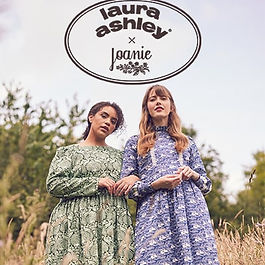
In 1953, inspired by a Women's Institute exhibition at the V and A Museum, Laura and Bernard Ashley started printing fabrics in their kitchen. They soon started selling tea towels, and in 1955 opened a showroom in Old Burlington Street in London.
Gardening aprons and smocks marked a move towards garments.
In 1959, Laura Ashley started to use flower motifs, something the company would become well known for. Once the Ashley family relocated to Mid Wales and opened a shop in Machylleth, Laura Ashley began to experiment with historical styles.

After initially having a small factory in Kent, an old social club in Carno provided a new location for the Welsh factory. Five years later, the company was so successful they moved to disused railway station to build a new factory.

Through the 1960s and 1970s, there was a boom in small British led boutiques that would shape the British high street for the next few decades. Along with other British female designers, such as Mary Quant and Barbara Hulanicki (Biba), Laura Ashley became a household name and her dresses, especially her floral, prairie-style, maxi dresses became highly desirable and synonymous with the era.

Throughout the 1970s, the Laura Ashley brand achieved international recognition and in 1980 they launched their homewares catalogue. Laura Ashley passed away in 1985 and the company was floated on the stock market.

By the 2000s, the brand had started to fall out of favour and focused back on homewares. The late 2010s and early 2020s started to see a revival for the brand as original pieces appeared in vintage shops but the company went into administration

'Laura Ashley : From Kitchen to Catwalk'

Extended until Summer 2026

February 2024-November 2026
Dame Elisabeth Frink RA
(1930-1993)

Dame Elisabeth Frink was greatly affected by her up bringing during the Second World War and the military family she came from. Her work examines the strength and vulnerability of the male form. She was fascinated by birds and often depicted them. Using wire frames, Frink would build up her sculptures with plaster before casting them in bronze. In her lifetime she created 403 sculptures. As well as sculptures Frink drew, painted and designed in other mediums.

Her art career started at Guildford Art School before she went on to Chelsea School of Art. Upon graduating in 1952, her first exhibition was entitled 'Humans and Other Animals'. Through the 1950s and 1960s, she taught at the Chelsea School of Art and St Martin's School of Art in London, alongside her blossoming art career. Whilst living and working in France in the late 1960s that she first started to experiment with her so-called 'Goggle Head' statues, partly inspired by the glasses worn by General Oufkir and to examine oppressive regimes. Upon returning to the UK, she moved to Dorset in 1976 and the following year she was elected as a Royal Academician. In 1982 she was awarded a DBE and continued to exhibit her work and take on large scale sculpture commissions including The Walking Madonna in 1981 which stands outside Salsbury Cathedral. Her final work, The Welcoming Christ, for Liverpool Cathedral was unveiled a few days before her death from cancer in 1993. Many of her sculptures are on display in museums, galleries, towns, cities and religious buildings across Britain and the world.

Photographs and ephemera are available to study at Dorset History Centre. The Museum of Dorset holds the Elisabeth Frink collection.

The textiles on display are from the Frink Archive at The Blandford Fashion Museum, provided to The Blandford Fashion Museum in accordance with the wishes of the artist's late son, Lin Jammet.

'The Textile Collection of Elisabeth Frink'

February 2024-November 2026

Power Dressing: 1770-1990

Fashion and textiles have long been signifiers of power and wealth. Throughout the ages, the colour and fabric of garments communicated the status of the wearer.
Certain fabrics and colours have even been banned for lower classes. The style of a garment can enable the wearer to create a statement and take up space. The production of textiles has the power to create fortunes and destabilise entire economies.

This exhibition is split into two rooms. The Powerful Silhouette focuses on how emphasis on shoulders in women's wear can create a commanding figure, from the shoulder pads of the 1980s to Romantic leg-of-mutton sleeves of the 1820s.

Power & Textiles examines the cultural and economic significance of certain fabrics through time, from sumptuary laws and velvet to paisley shawls and The British Empire.
See handout for more information.

'Power Dressing'

February 2025 - November 2026

Through the 1910s to the 1990s explore how fashion trends and personal choice saw the development of wedding dresses, from fairytale gowns to floral suits and everything in-between.

'20th Century Brides : A Hundred Years of Wedding Dress'

16th February 2026


Blandford Fashion Museum is excited to announce the upcoming exhibition, 'Youthquake:1960s', as part of the Fashioning Our Future project with The Salisbury Museum. Thanks to funding received from The National Lottery Heritage Fund for the Fashioning Our Future project, students from Arts University Bournemouth and local Sixth Forms have been working with the museum team to bring to life this dynamic exhibition.

Choosing objects from the museum’s extensive fashion collection, the students explored 1960s boutique fashion alongside homemade garments encapsulating the free-spirited energy of the 1960s. Many of the garments featured in the exhibition represent innovative sartorial statements expressed during the 1960s era through bold garments made at home. This adventurous attitude to style is a theme that resonated with the students, aligning with their concerns around sustainability and making conscious fashion choices.

In addition to marveling at the glorious 1960s fashions on display, visitors can also step into fashions of the era with a specially selected collection of garments for dressing up and handling. From crochet to patchwork, bold minidresses and boho maxi dresses, expect to be immersed in the 1960s era in this fantastic fashion exhibition.

'Youthquake:1960s'

16th February 2026

acredited museum.jpg

Blandford Fashion Museum

Lime Tree House

11 The Plocks

Blandford Forum

DT11 7AA

01258 453006                                                          

Charity Number (Cavalcade of Costume Ltd): 1052471

Opening Times

Monday, Thursday, Friday, Saturday

10am-4.30pm (last entry 4pm)

Closed 1st December 2025 - 14th February 2026

Entry Charges

Adults – £6.00
Seniors (60+) – £5.00
Students (16+) – £4.00           

Children under 16 – Free
Friends of the Museum – Free       

Essential Carer – Free

Please note that under 16s must be accompanied by a fee paying adult

bottom of page